Learning Russian · 7 min read
Is Russian Worth Learning in 2026? One Reason That Changes Everything
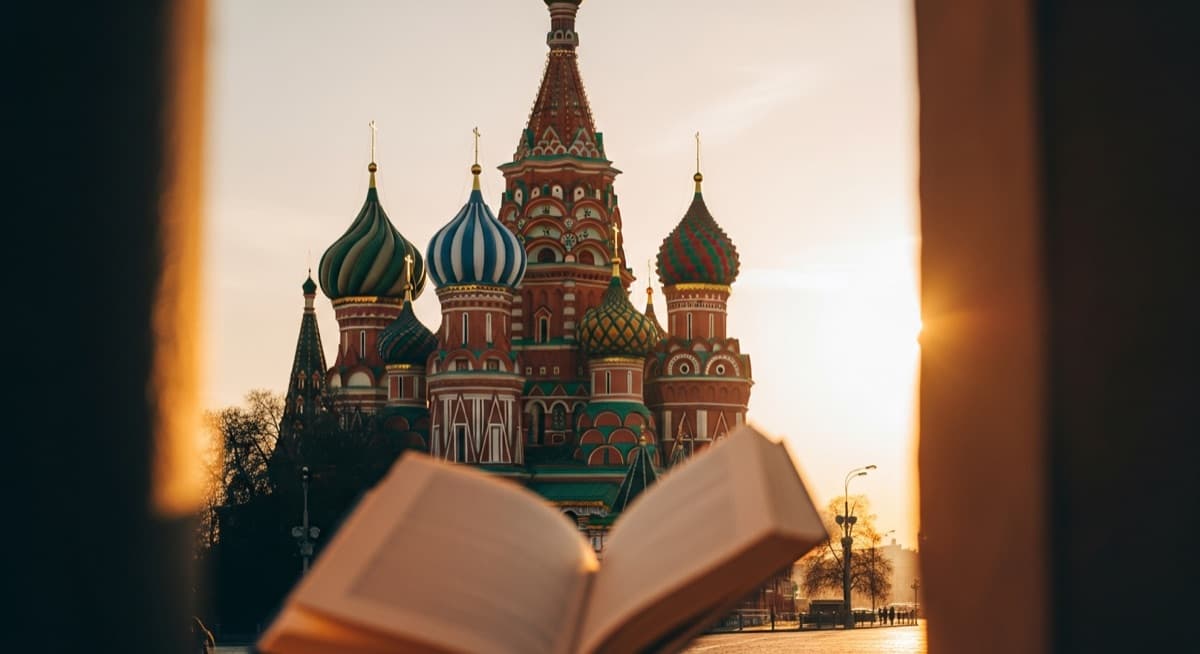
You probably already have a reason you're asking. Maybe there is a Russian speaker in your life - a partner, a colleague, a friend - and you are wondering whether putting in the effort to learn their language is actually going to pay off. Or maybe you are just curious, drawn in by the culture or the literature or the sheer challenge of it. Either way, you are asking a very fair question: is Russian worth learning in 2026?
Let me give you an honest answer. No sugarcoating.
The Honest Case for Learning Russian in 2026
Russian is the 8th most spoken language in the world by number of native speakers. It is the primary language of Russia, Belarus, Kazakhstan, and Kyrgyzstan, and it is widely understood across much of Ukraine, the South Caucasus, and Central Asia - a combined population of well over 200 million people.
It is the language of Tolstoy, Dostoevsky, Chekhov, and Bulgakov. It is the language of the Bolshoi Ballet and the music of Tchaikovsky. If you ever travel to Moscow, St. Petersburg, or Minsk, even a basic grasp of Russian will open doors that stay firmly shut for most tourists.
So on the surface level, Russian is absolutely worth learning. The reach is enormous and the cultural depth is real.
But if I am being honest, most people who ask me this question are not asking it because of Dostoevsky.
The One Reason That Actually Changes Everything
I have been teaching Russian for more than five years. And in every single lesson - no matter the student, no matter the country they are from - I get the same questions. Who should pay on a first date in Russia? What does it mean when she introduces you to her family? Why did her mum give me an even number of flowers at the funeral - wait, flowers at a funeral?
Those questions are not about grammar. They are about connection.
The students who go from "I wonder if I should bother" to "I cannot imagine not knowing this language" almost always have one thing in common: there is a person. A Russian-speaking partner, a set of in-laws who do not speak English, a grandmother who only lights up when you try a few words in her language.
That is the reason that changes everything.
When you can say even a few real things in Russian - not textbook phrases, but the things that actually come up - the whole relationship shifts. You stop being the outsider who gets translated for. You start being someone who made an effort, who wanted to understand. In Russian culture, that matters more than you might think.
I am from Belarus myself. We speak Russian there. And I know from the inside that when a foreigner makes the effort to learn even a little Russian, it is not seen as a party trick. It is seen as respect.
What Russian Culture Actually Rewards
Here is something I talk about with my students all the time. Russian relationships - and I mean this in the broadest sense, not just romantic ones - are built on a different foundation than what a lot of people in the West are used to.
We tend to be more exclusive, faster. After the second or third date, you are already more or less together - none of that two-or-three-month "are we or aren't we" period that seems so common in Western dating culture. Commitment is taken seriously early. Family is central.
And family means language. If you are with a Russian partner and you meet her parents, her grandmother, her aunts at the dinner table - those people are not switching to English for you. That dinner table is where the real relationship gets built or gets lost. Knowing how to say something genuine in Russian, even imperfectly, is worth more in that room than any gift you could bring.
(Speaking of gifts - never bring an even number of flowers. Even numbers are for funerals. Bring eleven, or seven, or nine. You are welcome.)
What You Actually Need to Get Started
Here is the good news: you do not need years of study to make a real difference.
Russian has a reputation for being impossibly hard. The Cyrillic alphabet looks intimidating. The grammar cases sound nightmarish. But I have watched students work through the Simple Russian e-book and go from zero to reading Cyrillic in an afternoon. Seriously - an afternoon. The alphabet is not random symbols, it is a system, and once you see the system it clicks fast.
The grammar cases are real, I will not pretend otherwise. But here is what I tell every student: you can say meaningful, correct, warm things in Russian long before you have mastered the cases. Speak first. Perfect later.
A few phrases to start with right now:
| Russian | Pronunciation | English |
|---|---|---|
| Привет | Pree-vyet | Hi (informal) |
| Здравствуйте | Zdra-stvooy-tye | Hello (formal) |
| Спасибо | Spa-see-ba | Thank you |
| Я учу русский | Ya oo-choo roo-skee | I am learning Russian |
| Ты очень красивая | Ti och-en kra-see-va-ya | You are very beautiful |
| Мне нравится твоя улыбка | Mnye nra-vit-sya tva-ya oo-lip-ka | I love your smile |
| Как дела? | Kak dye-la | How are you? |
| Я рад тебя видеть | Ya rad tye-bya vee-dyet | I am glad to see you |
Those last two phrases are not random. They are the kind of thing that lands - the kind of thing that makes someone look up from whatever they are doing and actually see you.
Is Russian Hard? (Honest Answer)
Yes, harder than Spanish or French. No, not as hard as you fear.
The Cyrillic alphabet takes a day, not a semester. Basic conversation takes a few months of real practice, not years. Reading simple texts - menus, signs, messages from your partner - is within reach in weeks if you go about it the right way.
The cases (Russian has six of them) are genuinely tricky, and I am not going to tell you otherwise. But here is my honest take after years of teaching: the cases are the last thing that should stop you from starting. You will pick them up gradually as you speak more. They are not a wall you have to climb before anything else makes sense.
Russian Literature and Culture: The Longer Reward
For those who go further, Russian opens up one of the richest literary and artistic traditions in the world. Pushkin's poetry. Bulgakov's dark satire. The layered moral world of Dostoevsky. These things lose something essential in translation - not everything, but something.
Beyond literature, there is the music (classical and folk), the cinema (Tarkovsky, Zvyagintsev), the architecture, the food culture, the humor that does not always survive being explained in English. The more Russian you know, the more of that world becomes available to you directly, not through someone else's filter.
That is a real, long-term reward that keeps growing the more you put in.
So, Is Russian Worth Learning in 2026?
Here is my honest answer:
If you have a Russian-speaking person in your life - a partner, a partner's family, a close friend - then yes, without question. The effort is not just worth it, it is one of the best investments you can make in that relationship. Not because language is magic, but because the attempt itself communicates something that no gift and no amount of good intentions quite does.
If you are drawn to the culture, the literature, the travel - yes. Russian takes you places (literally and figuratively) that English alone cannot.
If you are learning for a job requirement with no personal connection - it depends on the job, and that is an honest "maybe".
But for most people reading this? The reason is already there. You just need someone to tell you it is enough of a reason to start.
It is. Start today.
Where to Begin
The fastest path I know is to get the alphabet down first - it is the foundation everything else builds on. Then move into real phrases, real context, real culture. That is the order that actually works.
My Simple Russian e-book is built exactly for that: a beginner who wants to speak, not just study, and who wants to understand the Russian they are learning, not just memorize it. No Soviet textbook energy. Just clear, warm, practical Russian from a real teacher who has answered these exact questions thousands of times.
Whatever brought you to this question - you are asking the right one. The answer is yes.